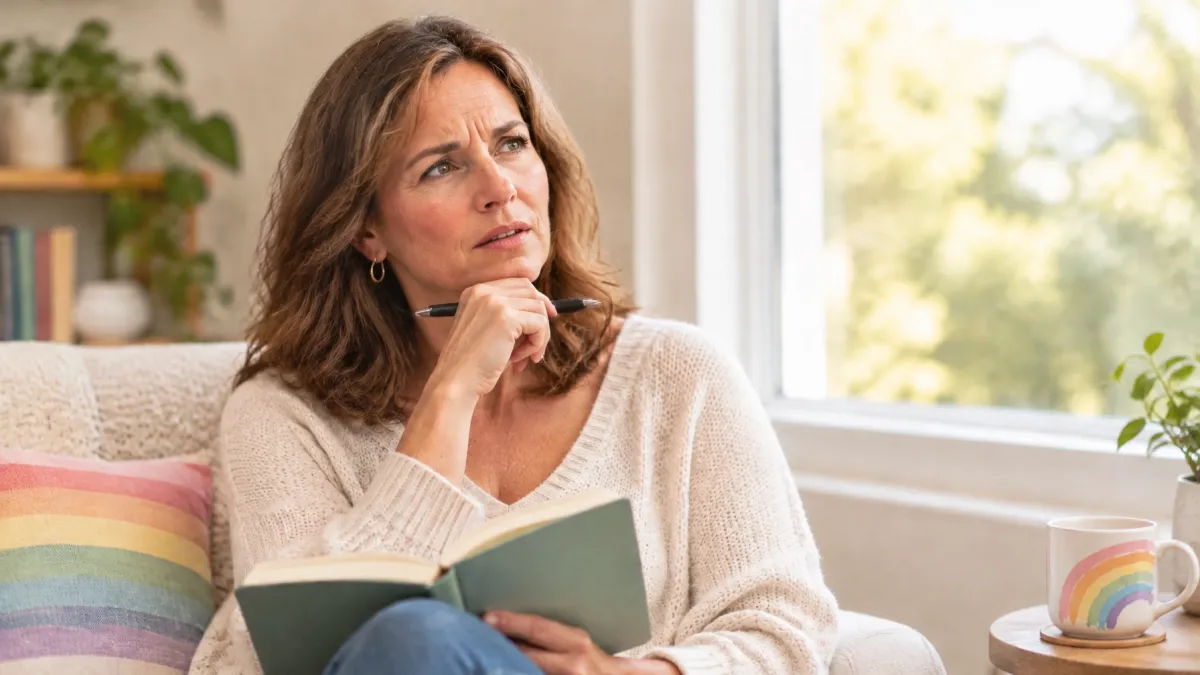
Am I a Lesbian or Just Unhappy in My Marriage? How to Tell the Difference
Am I a Lesbian or Just Unhappy in My Marriage? How to Tell the Difference

If you’re asking yourself, “Am I a lesbian, or am I just unhappy in my marriage?” you may be hoping for one clear answer that makes everything else fall into place.
But these questions can be tangled together. You can be unhappy in your marriage and also be discovering something important about your sexuality. One doesn’t cancel out the other, and you don’t have to solve both questions today.
Maybe you’re wondering whether your feelings about women are real, or whether they’re simply a reaction to what’s missing with your husband. Maybe you worry you’ll hurt someone you love if you get it wrong. If that’s where you are, please know: confusion is normal, and you’re allowed to take time to understand yourself.
Unhappiness and sexuality are different questions
Marriage unhappiness is about how a particular relationship feels and functions. You might feel lonely, unheard, resentful, or disconnected. You might be struggling with communication, intimacy, different goals, or years of unresolved hurt.
Sexuality is about your patterns of attraction and connection, not just whether one relationship is happy. It can include who you feel drawn to romantically, emotionally, or sexually over time. It’s personal, and only you can decide what words, if any, fit.
Sometimes these questions overlap. Relationship difficulties can bring long-buried feelings into focus. And you can care deeply about your husband while recognizing that you may not be straight. Love, commitment, and orientation don’t always fit into a simple either-or.
Here is something I’ve learned from my own journey and from walking alongside so many women on this path: what you desire speaks louder than why you’re unhappy. If you’re finding yourself drawn to, attracted to, or fantasizing about women, that tells you something about your sexuality — not just about the state of your marriage. Meanwhile, women whose marriages are unhappy but whose sexuality isn’t in question imagine very different lives: being with another man, or simply being on their own without a partner at all.
Truly straight women who are unhappy in their marriages don’t spend their days wondering what it would be like to kiss, hold, and build a life with a woman. If those thoughts keep showing up for you, they deserve to be taken seriously rather than explained away.
I know how complicated this can feel because I lived it. I was married to a man for 11 years. In 2018, my marriage ended as I came to understand that I was a lesbian. I’m now remarried to a woman. My experience doesn’t tell you what your answer should be, but I know how frightening it can feel to ask the question at all.
What might help you begin to Untangle the questions?
There’s no checklist that can diagnose your sexuality. But gently noticing patterns may help you hear yourself more clearly.
1. What has your attraction looked like across your life?
Try to remember periods before your marriage felt difficult. Were you drawn to women, even if you didn’t have words for it? Did you experience crushes, longing, fascination, or a sense of possibility around women?
And when you were with men, what did attraction feel like? Did you want that person, or did you want to be chosen, loved, safe, approved of, or part of the life you thought you were supposed to have?
These questions aren’t a test. They’re invitations to notice your own history with kindness.
2. What do you imagine when you picture a relationship with a woman?
When you imagine dating, loving, or building a life with a woman, what comes up? Excitement? Tenderness? Curiosity? Fear? Relief? A mix?
You don’t have to act on a feeling or turn it into a label for it to matter. Imagining a future can offer clues, but it can’t produce a verdict. There’s no requirement to date or have sex with anyone to prove who you are.

3. Is the distress specific to your husband, or to heterosexual partnership?
This can be a hard one. You might ask yourself: If my marriage became more loving and respectful, would I want to be in a relationship with a man? Or does the discomfort reach beyond this relationship, into the idea of being a wife to a man or having intimacy with men generally?
One useful comparison: when straight women are unhappy in their marriages, their escape fantasies usually feature other men, or the freedom of being single and on their own. If your fantasies feature women instead — their bodies, their softness, a life beside one — that’s a meaningful pattern, not a coincidence. What your mind reaches for when it imagines something better is a clue about who you are, not just what you’re missing.
Your answer may not come easily. You may not know yet. That’s okay. You’re exploring, not cross-examining yourself.
4. Could compulsory heterosexuality be part of the picture?
Compulsory heterosexuality, sometimes shortened to “comphet,” describes social pressure that treats being straight as the default. Messages from family, culture, religion, and media can shape what we expect from ourselves. Sometimes before we’ve had much room to ask what we truly want.
That pressure can lead someone to explain away attraction to women, or to assume that a lack of desire for men means something is wrong with her. So yes, the thought “Am I just unhappy?” might sometimes be a way of trying to make a difficult truth feel less disruptive.
But it might also be exactly what it sounds like: a question about a painful marriage.
I’ll be honest with you, because I wish someone had been honest with me: many women use the question “am I just unhappy?” as a way to soften, or even deny, the feelings that are coming up around women. The story goes like this: I’m unhappy, so maybe I only imagine I’d be happier with a woman. But if unhappiness were the whole story, your imagination would more likely offer you other men, or a life on your own. The fact that it keeps offering you women is worth sitting with gently, not hiding from.
If you're unfamiliar with comphet, you can read more about it here.
Questions you can sit with, without forcing an answer
You might choose one or two questions to journal about, rather than trying to solve your whole life in one sitting:
When have I felt most like myself in a relationship?
What do I want when no one else’s expectations are in the room?
Have I felt drawn to women even during times when my marriage was going well?
When I picture staying married, what feels comforting, and what feels heavy?
When I picture a future with a woman, what emotions show up?
Am I looking for a label because it feels right, or because I want certainty before I take any next step?
You might find that your answers change. That doesn’t mean you’re making things up. It may simply mean you’re learning to listen to yourself in a new way.
Take small, safe steps toward clarity
You don’t have to make a major decision to begin exploring. You could:
Journal privately. Write about attraction, affection, dread, comfort, and curiosity without correcting yourself.
Find affirming support. An LGBTQ+-affirming therapist or coach can help you explore both your relationship and your sexuality without steering you toward a particular conclusion.
Protect your privacy and safety. You decide what to share, when to share it, and with whom. If you’re worried about your partner’s reaction or your safety, seek confidential support before having a conversation.
Give yourself permission not to know yet. “Questioning” is a valid place to be.

You are not required to stay in your marriage, leave your marriage, come out, or choose a label today. Your task isn’t to arrive at the “right” answer quickly. It’s to make room for an honest one, at your own pace.
You don’t have to figure this out alone
When I was questioning, I felt isolated and wished I could talk with someone who understood this particular journey and experience. That’s why I now offer support to women navigating this path. My role is not to tell you what your truth is; it’s to help you feel less alone while you listen for it.
If you’d like a gentle place to begin, you can explore the free 4-day one-on-one experience I offer, browse the free resource library, or learn about The Late Life Lesbian online community.
You can come as you are: uncertain, curious, scared, hopeful, or all of those at once. There’s no rush to have everything figured out. 💛
